
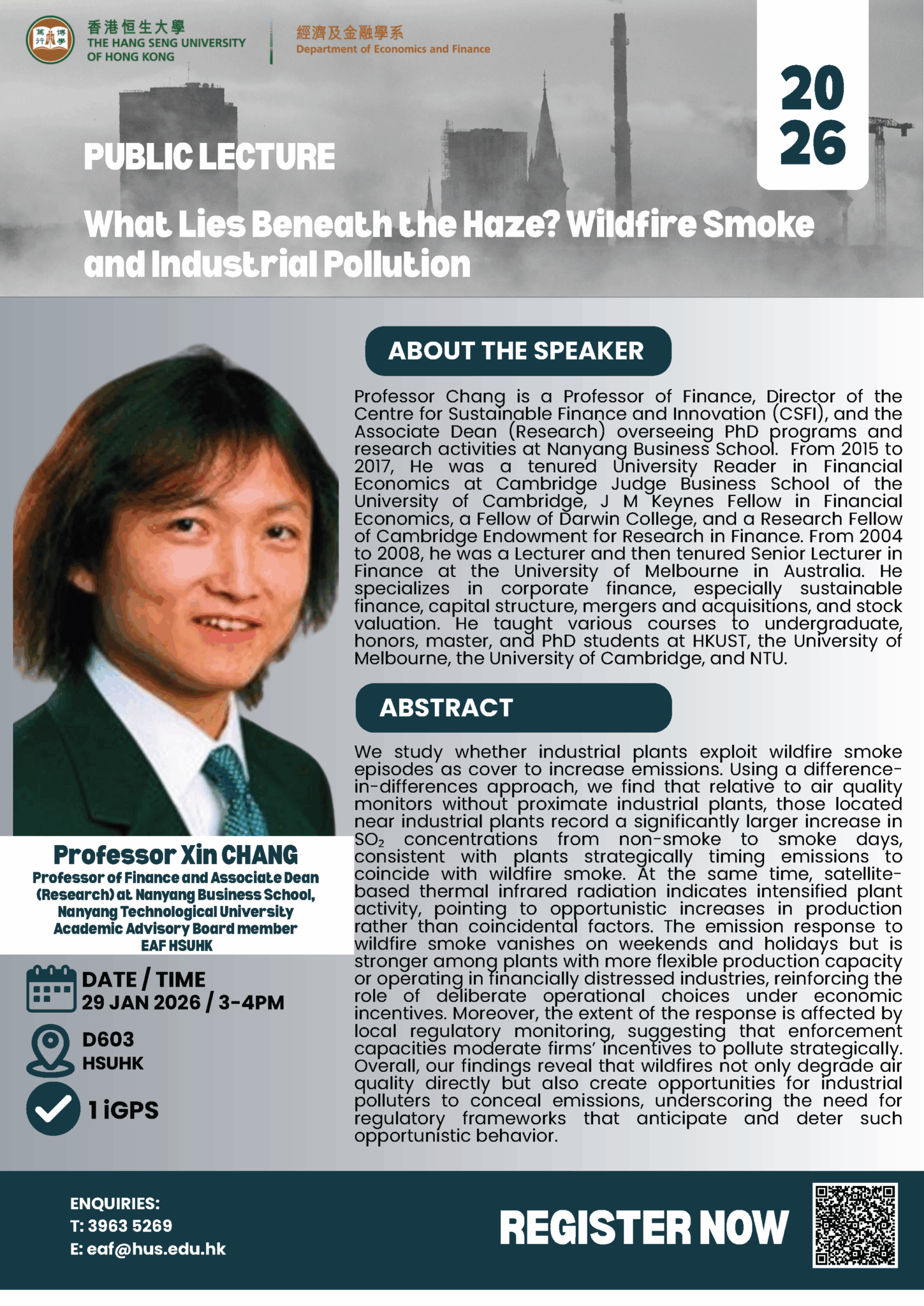
Event Title
What Lies Beneath the Haze? Wildfire Smoke and Industrial Pollution
About the Speaker
Professor Xin Chang
Professor of Finance and Associate Dean (Research) at Nanyang Business School, Nanyang Technological University Academic Advisory Board Member, EAF HSUHK
Professor Chang is a Professor of Finance, Director of the Centre for Sustainable Finance and Innovation (CSFI), and the Associate Dean (Research) overseeing PhD programs and research activities at Nanyang Business School. From 2015 to 2017, he was a tenured University Reader in Financial Economics at Cambridge Judge Business School of the University of Cambridge, J M Keynes Fellow in Financial Economics, a Fellow of Darwin College, and a Research Fellow of Cambridge Endowment for Research in Finance. From 2004 to 2008, he was a Lecturer and then tenured Senior Lecturer in Finance at the University of Melbourne in Australia. He specializes in corporate finance, especially sustainable finance, capital structure, mergers and acquisitions, and stock valuation. He has taught various courses to undergraduate, honors, master, and PhD students at HKUST, the University of Melbourne, the University of Cambridge, and NTU.
Abstract
We study whether industrial plants exploit wildfire smoke episodes as cover to increase emissions. Using a difference-in-differences approach, we find that relative to air quality monitors without proximate industrial plants, those located near industrial plants record a significantly larger increase in SO₂ concentrations from non-smoke to smoke days, consistent with plants strategically timing emissions to coincide with wildfire smoke. At the same time, satellite-based thermal infrared radiation indicates intensified plant activity, pointing to opportunistic increases in production rather than coincidental factors. The emission response to wildfire smoke vanishes on weekends and holidays but is stronger among plants with more flexible production capacity or operating in financially distressed industries, reinforcing the role of deliberate operational choices under economic incentives. Moreover, the extent of the response is affected by local regulatory monitoring, suggesting that enforcement capacities moderate firms’ incentives to pollute strategically. Overall, our findings reveal that wildfires not only degrade air quality directly but also create opportunities for industrial polluters to conceal emissions, underscoring the need for regulatory frameworks that anticipate and deter such opportunistic behavior.
Date and Time
29 January 2026 3:00 PM – 4:00 PM
Venue
D603, HSUHK (The Hang Seng University of Hong Kong)
Additional Details
- iGPS Units: 1 iGPS
- This event is organized by the Department of Economics and Finance, HSUHK, and aligns with the Centre of Global Finance and FinTech’s focus on sustainable finance and innovation.
Enquiries
- Telephone: 3963 5269
- Email: eaf@hsu.edu.hk
Registration
Register now to secure your spot! Scan the QR code on the poster or visit the registration link (if available; otherwise, contact enquiries for details).
We look forward to welcoming you to this insightful lecture on sustainable finance, environmental economics, and industrial practices. Stay tuned for more upcoming events from the Centre of Global Finance and FinTech!